




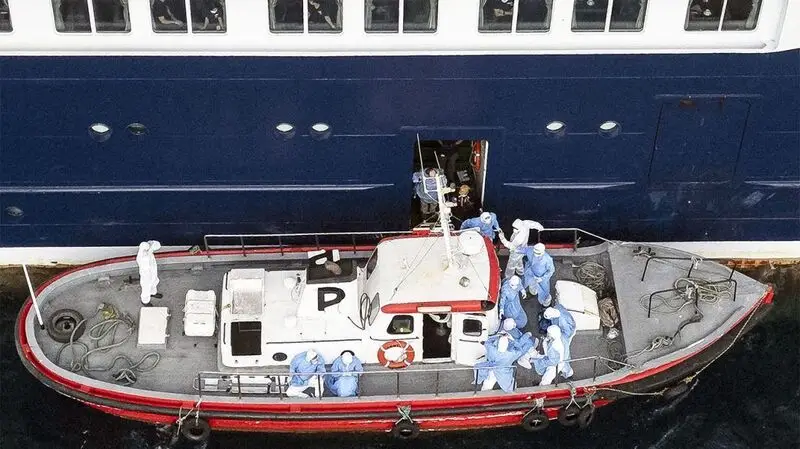
- A rare hantavirus outbreak has affected a cruise ship carrying nearly 150 people who were travelling from Argentina on a long-haul Atlantic journey.
- With a few confirmed deaths so far, several countries have ordered tracking and self-isolation for people at risk of suspected infection.
- However, the WHO currently maintains that the risk of human-to-human transmission and global spread is ‘low’ and the outbreak is under monitoring.
- Medical News Today spoke to three experts to find out what symptoms to watch out for, when to seek care, and what to do if they suspect contact with the hantavirus.
With international contact tracing efforts underway to track the passengers who disembarked the Dutch-flagged cruise ship MV Hondius early, concerns among the public about a larger outbreak of hantavirus have been growing.
What began with the confirmed
The ship, operated by Oceanwide Expeditions, was initially held off the coast of Cape Verde, and later authorized to sail toward the Canary Islands in Spain for further investigation.
Medical News Today spoke to three medical experts to learn more about how this virus spreads, what people can do to protect themselves, and whether this outbreak has the potential to turn into a bigger epidemic, similar to SARS-CoV-2:
- William Schaffner, MD, professor of preventive medicine in the Department of Health Policy, and professor of medicine in the Division of Infectious Diseases at Vanderbilt University Medical Center
- Justin Chan, MD, infectious diseases specialist at NYU Langone Health and Director of Infection Prevention and Control at Bellevue Hospital Center
- and Monica Gandhi, MD, MPH, an infectious diseases specialist with the University of California, San Francisco.
The Dutch man who died on April 11, 2026 aboard the MV Hondius had started to exhibit symptoms on April 6. This was 5 days after the ship had departed from Ushuaia, Argentina.
The ship
As of
Several passengers have also been reported to have been hospitalized, receiving care in South Africa, The Netherlands, Switzerland, Singapore, and Spain.
The total number of people on board the ship were 147 people, including crew.
As a number of passengers left the ship earlier and flew to their various home countries before the outbreak was confirmed, international tracing efforts have gained traction.
The WHO has declared the global risk of spread remains “low” as the outbreak is still confined to a small group of travelers. Meanwhile, the European Centre for Disease Prevention and Control (ECDC) has activated the Early Warning and Response System (EWRS) to alert public health authorities in Europe of the situation.
The
Health authorities have identified that passengers have been infected with the Andes strain of hantavirus (ANDV). Although hantaviruses rarely spread via human-to-human contact, this particular strain is known to have the ability to be transmitted from person to person.
For this virus to spread between humans, authorities say close, prolonged physical contact is needed.
The initial passengers are thought to have been exposed to infected rodents or droppings before they boarded the ship. This strain of the virus is endemic in South America, indicating that the virus maintains a predictable, low-level presence.
Hantaviruses have been linked to svere disease and death, and can cause a severe respiratory illness called hantavirus cardiopulmonary syndrome (HCPS), for which the case fatality rate is
Schaffner explained how people may get infected with the hantavirus.
“Hantavirus lives in small rodents in certain parts of the world, usually where the climate is rather dry. The virus is shed in the urine and feces of the rodents. People usually become infected when they stir up dried dust that contains the virus, causing an aerosol which is inhaled, thus initiating the infection,” he told MNT.
“In this cruise ship incident, the passengers boarded in Argentina. This is relevant, because a hantavirus variant, the Andes strain, occurs there and, different from other hantaviruses, the Andes strain can be spread from person to person,” he said.
“Humans can get infected with hantaviruses through contact with the urine, feces, or saliva of infected rodents,” Chan told MNT.
“Less commonly, human-to-human transmission has been seen in previous outbreaks involving the Andes hantavirus, which is unique as other hantaviruses are not known to spread human-to-human. Andes hantavirus spread between humans typically requires close and prolonged contact leading to exposure to infectious body fluids,” he explained.
Gandhi said this particular strain can spread from person to person as well as through rodent exposure.
“At least in prior outbreaks with the Andes Strain, the contact had to be close contact an infected person for spread, including direct physical contact, prolonged time spent in enclosed spaces, and exposure to the infected person’s body fluids,” she said.
With the cruise ship soon to dock in Spain, many people are worried about transmission and further spread. However, experts remain cautiously optimistic, considering the current efforts.
“At the moment, the cruise ship outbreak appears well confined. Some passengers have left the ship and have returned to their homes. At this moment, all are well and are being monitored by local public health personnel,” Schaffner said.
“The risk of substantial spread is very low; this should not be the start of another COVID-like epidemic,” he added.
Chan reiterated that a concerted effort to control the outbreak is underway.
“Global Health agencies have been leading a coordinated response including medical evacuations from the MV Hondius for passengers with severe symptoms. Public Health agencies will keep track of other individuals who may have been exposed on the ship to monitor closely for symptoms,” he said.
“Though the mortality rate for this virus is high, spread between humans is not common and requires close and prolonged contact with infected individuals. The overall risk to the general public at this time is deemed low,” he added.
Schaffner said that what makes it hard to identify infections with hantavirus is that it may go undetected for the first few days.
“Hantaviruses cause stealth infections. The initial phase of the illness seems rather mild, with fever, headache, feeling poorly, some muscle aches – it does not alarm the patient,” he said.
However, after initial exposure, the virus has a broad incubation period that can last anywhere from a few days to 1 to 8 weeks before the patient starts to feel the symptoms, according to the
“This can go on for 2 to 4 days and then the patient crashes, becomes seriously ill with hantavirus cardiopulmonary syndrome in which breathing becomes difficult, blood pressure drops and the patient feels very weak and sick,” he explained.
Chan said the Andes hantavirus causes symptoms such as fever, muscle aches, back pain, abdominal pain, vomiting and diarrhea.
“Severe illness follows with respiratory distress, pneumonia and drops in blood pressure. Lab testing is required to confirm hantavirus as the cause of illness,” he said.
Gandhi explained that there were two main syndromes caused by hantavirus: the Hantavirus Pulmonary Syndrome (HPS) or Hemorrhagic Fever with Renal Syndrome (HFRS).
“The kidney (renal) syndrome usually occurs in Asia or Eastern Europe and can be marked by fever, low platelets, acute kidney injury where urine production is down. The infected person can go into shock and have bleeding in the severe phases,” she said.
“The Andes strain causes lung symptoms and is found in South America generally. This syndrome is hallmarked by fever, shortness of breath, fluid in the lungs and shock. The patient can proceed to severe oxygen deprivation, bleeding, renal failure and require intubation and strong supportive care,” she added.
Currently there are no vaccines or antiviral treatments designed to target hantavirus.
“Treatment is supportive care, often in an intensive care unit. There are no specific antiviral drugs that work against hantaviruses,” said Schaffner.
Official guidelines from the WHO and the CDC suggest that people “rodent-proof” their homes by sealing any holes and gaps where animals may get in and setting traps.
They also advise people to wear personal protective gear and HEPA-filtered respirators (N95), while ensuring that the enclosed spaces with rodents are well ventilated and disinfected after they have been removed.
“Everyone who has disembarked should be isolating at home for up to 6-8 weeks to monitor for symptoms and contact public health immediately if there are symptoms so they can be tested,” Gandhi said.
“The general public is not generally at risk as hantavirus requires close contact and not more casual contact as with COVID-19 which can be spread by being near someone in a store who is coughing, for example, but the passengers are hopefully isolating at home at this point as encouraged by public health,” she added.
But will identifying the origins of this hantavirus outbreak be as difficult as SARS-CoV-2, the virus that causes COVID-19?
“[H]antavirus is not a new virus to humans as SARS-CoV-2 was so at this point, we think there was exposure from rodents to a few people boarding the ship from activities (such as bird watching in places with rodents) performed beforehand and then there was person to person spread on the ship,” said Gandhi.
“The originator of the virus was still likely rodent waste but the concern here is that the strain that led to this outbreak is spread person to person from close contact,” she said.
Chan explained that the Andes hantavirus was first discovered in Argentina in 1995, and nowadays, most commonly found in Argentina and Chile.
“While public health investigations are ongoing, given this cruise ship itinerary started in Argentina, it is most probable that at least the initial case was due to exposure to infected rodents found in that region,” he said.
Schaffner, meanwhile, underscored the importance of global preparedness in the face of such public health threats.
“This outbreak is a reminder of how small the globe is, how interconnected we are and how important the WHO is to epidemic preparedness,” Schaffner said.
“Scientists already are working on identifying the specific virus causing the outbreak. Public health authorities have begun their investigation of how the outbreak started. This still is in its early stages, so stay tuned,” he said.
Schaffner also noted that as this event unfolds and more information surfaces, medical experts’ recommendations may change, and people exercise caution and diligence.