




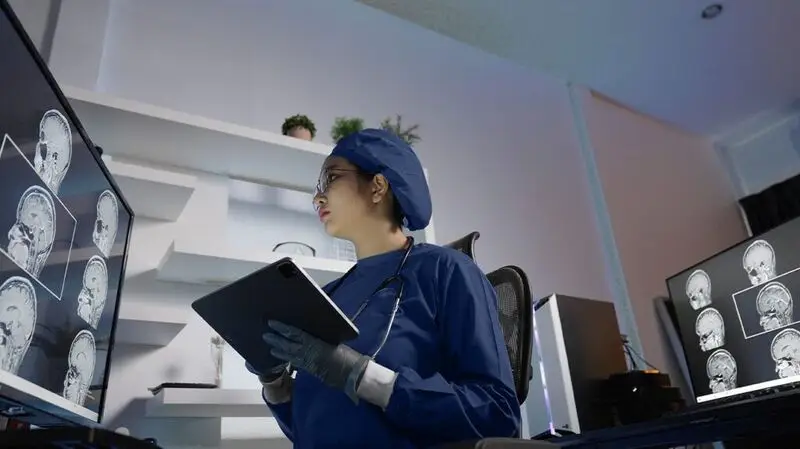
- The wellness of the brain plays an important role in living a long, healthy life.
- For this reason, being able to early detect — and possibly prevent — brain-related health issues like dementia, brain aging, and brain cancer is extremely important.
- Researchers at Mass General Brigham have developed a new AI model trained using data from brain MRI scans to help doctors better predict and detect brain health concerns like dementia risk, brain age, and brain tumor mutations.
As the brain is one of the most important organs in the body, its wellness plays an important role in living a long, healthy life. For this reason, being able to early detect — and possibly prevent — brain-related health issues like dementia, brain aging, and brain cancer is extremely important.
To help doctors better predict and detect brain health concerns like dementia risk, brain age, and brain tumor mutations, researchers at Mass General Brigham have developed a new artificial intelligence (AI) model trained on almost 49,000 brain MRI scans.
Researchers believe being able to analyze a large amount of data at one time may provide a better ability for doctors to identify, predict, and treat brain diseases.
A study on this new AI tool was recently published in the journal
The AI tool that researchers at Mass General Brigham developed is called Brain Imaging Adaptive Core (BrainIAC).
“BrainIAC is an AI foundation model that is trained on tens of thousands of brain MRI scans to understand how the brain is structured,” Benjamin Kann, MD, faculty member of the Artificial Intelligence in Medicine (AIM) Program at Mass General Brigham; and corresponding author of this study, told Medical News Today.
“Using this core baseline knowledge, the tool can then be adapted to identify various brain diseases, determine their severity, and predict future risks from these diseases,” said Kann, who is also an associate professor of radiation oncology at Brigham and Women’s Hospital, Dana-Farber Cancer Institute, and Harvard Medical School.
“There is a vast trove of data within the millions of brain MRIs performed each year in the United States,” Kann continued.
“Typically, these scans are analyzed by humans for a particular reason, but this only scratches the surface of the story that these scans might tell us about our patients.”
“With AI and advanced computational imaging techniques, we are able to unlock much more information from these scans than ever before — which may lead to potent, clinically useful ways to track a variety of acute and chronic conditions, from stroke, to cancer, to dementia, as well as predict future risks for patients,” he added.
Through their study, researchers validated BrainIAC’s performance on almost 49,000 diverse brain MRI scans. This allowed scientists to determine that the AI model is capable of analyzing these MRI scans to help identify brain age, predict dementia risk, detect brain tumor variations, and predict brain cancer survival rates.
“Identification of these problems will inform clinicians and patients what type of treatment or preventive measures should be taken to reduce future risk, ultimately improving quality of life and survival,” Kann explained.
“For instance, predicting a high risk of dementia would alert the clinician that this patient should start interventions such as physical exercise, cognitive training, and vascular/metabolic risk management to reduce this risk as much as possible.”
“Patients with a particular brain tumor mutation identified may be eligible for targeted therapies aimed at that mutation to improve their disease control.”
Kann and his team also discovered that BrainIAC outperformed other, more task-specific AI models, and was especially productive when limited training data was available.
“Perhaps the biggest challenge to developing accurate, robust, clinically-translatable AI models for medical imaging is the lack of large, well-labeled datasets, which often rest in siloed hospital databases and require significant manual effort to organize,” Kann said.
“With BrainIAC, we show that when you pre-train a model with unlabeled data — which is much easier to find in large quantities — the model can establish a core knowledge from which it needs much less labeled data for a particular task to perform well.”
“This opens the door to MRI-based models that can be trained from much less labeled data.”
“For instance, a clinical team could adapt BrainIAC for use at their own institution with a small dataset to predict things like cancer control, dementia, or even tasks not included in our study, like multiple sclerosis progression or intracranial bleed — without needing thousands of labeled scans for training, which are often infeasible to obtain,” he added.
Kann said they have already received numerous queries from research on how to adapt BrainIAC to various brain MRI applications.
“We have released BrainIAC in its current [form as] open-source for research purposes so that it is available to any researcher or practitioner,” he explained.
“In the future, we plan to improve upon the model and expand its application to additional brain disease.”
MNT had the opportunity to speak with Walavan Sivakumar, MD, a board certified neurosurgeon, director of neurosurgery, and chief of staff at Providence Little Company of Mary in Torrance, CA, about this study, who commented his initial reaction was one of cautious optimism.
“From my standpoint, what stood out was not just that this model can perform multiple tasks — we have seen that before — but how it was trained,” Sivakumar explained.
“BrainAIC’s use of self-supervised learning across 48,965 diverse brain MRIs addresses a historical criticism of where clinical AI is right now: these models can work well in an academic silo, but not applicable to real-world heterogeneous settings.”
“I am still surprised a single foundation model was able to generalize across several tasks like brain aging, dementia risk, tumor biology, and survival,” he continued.
“This is more impressive particularly in clinical scenarios where the labeled data is limited — the study showed BrainIAC particularly excelled when training data was scarce, 10% availability scenarios. This represents a more realistic approach than developing a different narrow algorithm for each clinical question.”
Sivakumar said it is important for researchers to continue to find new ways of analyzing brain MRI datasets as there is a significant amount of information from brain MRIs that are not currently extracted in regular clinical practice.
“Clinicians are trained and quite facile at pattern recognition but qualitative interpretation remains challenging,” he continued.
“Advanced models like this can identify subtle, distributed signals, like early patterns of atrophy or microstructural changes seen in tumors, that are either not visible to the human eye, or we don’t have standardized reports for.”
“For disease states like dementia and brain cancer, where earlier risk stratification or more accurate prognostication can have tremendous impacts on counseling, surveillance and treatment planning, these insights matter tremendously,” Sivakumar added.
“Additionally, the ability to analyze MRIs across institutions and across imaging platforms is critical if these tools are going to be able to be adopted in real clinical practice.”
MNT also spoke with Lana Zhovtis Ryerson, MD, FAAN, director of neuroimmunology division at the Jersey Shore University Medical Center and associate professor of neurology at Hackensack Meridian School of Medicine in New Jersey, about this new research.
Ryerson commented that she was very impressed with the breadth of abilities of this AI model across so many different functions of neuroradiology.
“It is important to continue to find new ways of analyzing brain MRI datasets because we do not have reliable and easy to use resources to do these things in clinical practice,” she explained.
“Across the neurology field, we recognize that it is important to recognize disease processes early as it gives us the best chance to treat effectively and prevent worsening. Yet, too often, we see delays in diagnosis due to lack of biomarkers and inconsistent recognition of risk factors or red flags among patients.”
“I would like to see this AI model evaluated in clinical practice,” Ryerson added.