




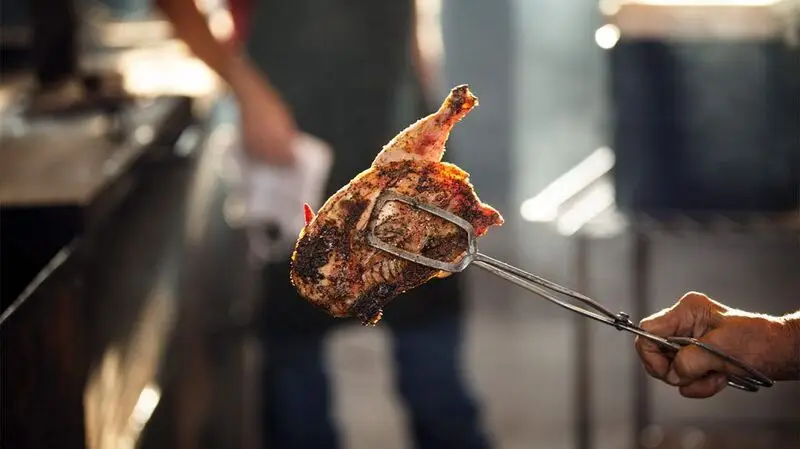
- People with the APOE4 allele in the 4/4 genotype had a lower risk of cognitive decline and dementia if they consumed relatively high amounts of meat.
- Eating a greater proportion of unprocessed meat was also associated with less all-cause mortality among this group of people.
- The APOE4 allele is the strongest risk factor for developing Alzheimer’s disease.
In a new observational study from Sweden, people with a genetic risk factor for developing Alzheimer’s disease had a lower risk of developing this form of dementia if they consumed large amounts of meat.
“Those who ate more meat overall had significantly slower cognitive decline and a lower risk of dementia, but only if they had the APOE 3/4 or 4/4 gene variants,” said study author Jakob Norgren, PhD, in a press release.
This finding might come as a surprise considering that
“There is a lack of dietary research into brain Health,” argued Norgren, “and our findings suggest that conventional dietary advice may be unfavourable to a genetically defined subgroup of the population.”
The study, published in
The data came from the Swedish National Study on Aging and Care-Kungsholmen (SNAC-K), which followed the adults for up to 15 years.
Each person would have an assessment every 6 years until they reached the age of 78. After this point, they would have a check-up every 3 years.
At every assessment, the participants would report:
- how much meat they had consumed over the previous year
- what proportion of the total meat they had eaten was processed meat
- how much unprocessed red meat they had eaten compared with poultry
Alongside this, the researchers looked for new diagnoses of dementia as well as data showing how cognitive functioning changed over time.
The other key variable that the researchers were interested in was whether or not people had specific genetic variants or not. These gene variants were APOE 3/4 and APOE 4/4.
APOE is a gene that helps the body to make a particular type of protein that can combine with fats to make molecules called lipoproteins that play a role in cholesterol management.
There are three different forms, or alleles, that APOE can take: APOE2, APOE3, and APOE4. As people inherit one allele from each of their parents, this means that there are six different possible variants: 2/2, 2/3, 2/4, 3/3, 3/4, and 4/4.
The APOE4 allele is the strongest risk factor for developing Alzheimer’s disease. A significant number of people with the condition have the allele in the 4/4 genotype.
“This study tested the hypothesis that people with APOE 3/4 and 4/4 would have a reduced risk of cognitive decline and dementia with higher meat intake, based on the fact that APOE4 is the evolutionarily oldest variant of the APOE gene and may have arisen during a period when our evolutionary ancestors ate a more animal-based diet,” said Norgren in the press release.
The researchers found that cognitive decline and dementia prevalence among people with the APOE 3/4 and 4/4 genetic variants appeared to be tempered by the amount of meat they consumed.
Among the people who ate the least meat, the ones with the APOE 3/4 and 4/4 variants had over twice the risk of dementia than those who did not have these variants.
However, there was no increase in risk of dementia or cognitive decline among the people with these genetic variants who ate the most meat.
The group that the researchers labeled as having the highest intake of meat ate an estimated 870 grams (g) of meat per week.
The type of meat that the people ate also had an impact on outcomes, as co-author Sara Garcia-Ptacek explained in the press release.
“A lower proportion of processed meat in total meat consumption was associated with a lower risk of dementia regardless of APOE genotype,” Garcia-Ptacek said.
Eating a greater proportion of unprocessed meat was also associated with less death among the people with the APOE genetic variants in a follow-up analysis.
Medical News Today asked Norgren why he thought a higher intake of meat was associated with slower cognitive decline and a reduced risk of dementia for people with APOE 3/4 and 4/4.
“At this stage, we can only speculate,” he told us. “Protein intake didn’t seem to explain the findings, so we carried out additional analyses looking at vitamin B12 levels in both diet and blood. We saw differences between APOE genotypes there as well, which suggests that how nutrients are delivered in foods—the so-called food matrix—may play a role.”
The researchers point out that other studies have spotted similar patterns in large cohorts, with unprocessed red meat consumption having an impact for people with APOE4.
It is worth noting that this new study was an observational one, and so does not prove that the meat consumption was necessarily driving the changes in risk the researchers pointed out. Follow-up intervention studies will be the next step to dig deeper into this relationship.
“This type of investigation cannot prove that the meat consumption was the cause of reduced dementia risk as other factors such as socioeconomic status likely influence unprocessed meat consumption,” said Tara Spires-Jones, FMedSci, in a briefing for the media.
Spires-Jones is the Director of the Centre for Discovery Brain Sciences at the University of Edinburgh in the United Kingdom and was not involved with the study.
As a lot of dietary advice for cognitive Health focuses on diets that are high in plants and relatively low in meats, MNT asked Norgren what he thought about this in light of the study’s findings.
“It’s possible that such recommendations still benefit a large proportion of the population,” he said, “but our findings suggest that APOE 3/4 and 4/4 carriers may have different dietary needs.
“Since this genetic subgroup accounts for the majority of Alzheimer’s cases, a potential mismatch between their specific needs and official dietary recommendations could have a large impact at the population level,“ Norgren added.
“If future research confirms these findings and allows us to develop more individualized recommendations, the potential for dementia prevention could be substantial,” he told us.
MNT also spoke with Steven Allder, MD, a consultant neurologist at Re:Cognition Health who was not involved with the study, about the findings.
“The study reinforces the importance of a personalized approach,” Allder said. “While plant-focused diets remain broadly beneficial, the optimal balance of protein sources, including lean meats, may differ based on genetics, cardiovascular risk, and lifestyle.“
“Rather than universally restricting meat, clinicians and individuals should consider overall dietary quality, nutrient density, and individual tolerance. In practice, a flexible, nutrient-rich diet that prioritizes whole foods while accommodating individual variation is likely to offer the most sustainable benefits for cognitive health.”
– Steven Allder, MD