




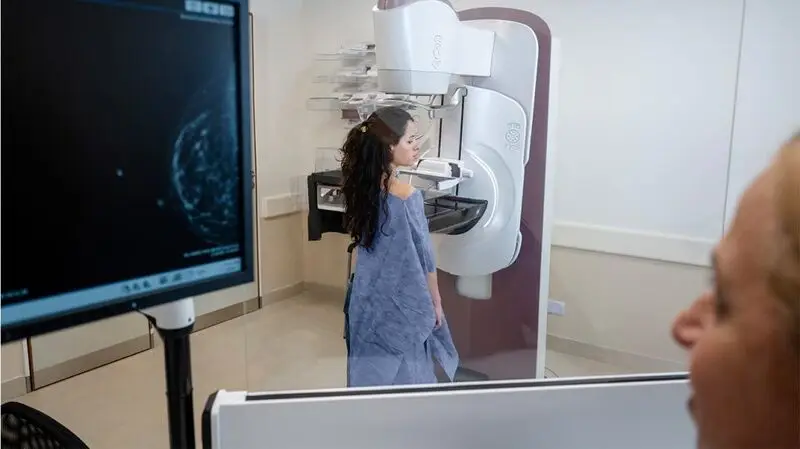
- Three AI-based mammography systems were able to identify subtle signs of future breast cancer years before diagnosis, with elevated cancer prediction scores seen in those who later developed the disease.
- In the study, approximately 20% of breast cancer cases showed AI-detectable mammographic changes as early as 6 years before diagnosis.
- At 90% specificity, the AI systems flagged potential future cancers in up to 19.7% of women 6 years before diagnosis, 25.2% 4 years before diagnosis, and 39.3% 2 years before diagnosis.
- The findings suggest AI could support earlier breast cancer detection and help enable more personalized screening strategies by identifying females who may benefit from closer monitoring or earlier intervention.
Artificial intelligence (AI) is becoming an increasingly valuable tool in cancer detection,
Advanced AI algorithms can analyze medical images, such as mammograms, to detect subtle changes that may be difficult to otherwise detect. By assisting with early diagnosis, AI has the potential to improve patient outcomes, reduce diagnostic errors, and support more personalized treatment plans.
Now, researchers suggest that 3 commercially available AI tools could help identify subtle mammographic changes years before breast cancer is diagnosed, potentially detecting early signs of breast cancer up to 6 years before a formal diagnosis.
Published in Radiology, the AI systems consistently assigned higher cancer risk scores to women who later developed breast cancer, while generating lower scores for those who remained cancer-free.
The findings add to a growing body of evidence suggesting that AI could play an increasingly important role in improving breast cancer screening and identifying cancers at an earlier, potentially more treatable stage.
In the Swedish retrospective study, researchers analyzed 88,963 mammograms from more than 31,000 participants, collected over a 10-year period between 2008 and 2019, through the Validation of Artificial Intelligence for Breast Imaging database. This database includes breast imaging data from volunteers across 4 regions of Sweden.
During the study period, 12,072 females were ultimately diagnosed with breast cancer after routine screening assessments by radiologists.
The researchers applied 3 commercially available AI-based computer-assisted detection (AI-CAD) systems to historical mammograms and evaluated whether the tools could identify subtle signs of cancer before radiologists made a diagnosis.
The AI systems were able to identify a proportion of future cancers several years before diagnosis while maintaining a specificity rate of 90%. This means they correctly distinguished most people without cancer from those who would later develop the disease.
Notably, the AI systems identified potential cancer-related abnormalities in up to 19.7% of women 6 years before diagnosis. As such, roughly 1 in 5 breast cancer cases may show mammographic features detectable by AI around 6 years before they are recognized through standard screening methods.
The AI systems were also able to detect early breast cancer signs in up to 25.2% and 39.3% in females 4 and 2 years before diagnosis, respectively.
“Our study shows that, for many patients, cancer signs detectable by AI appear several years before human radiologists find the signs suspicious enough to lead to clinical work-up and diagnosis of breast cancer,” senior co-author Fredrik Strand, MD, PhD, of Karolinska University Hospital in Stockholm, told Medical News Today.
The findings demonstrate AI’s ability to identify subtle imaging patterns that the human eye may miss at an early stage. The AI-generated cancer prediction scores could eventually help radiologists identify people who may benefit from closer monitoring or more personalized screening strategies.
In the United States, organizations suggest different guidelines for breast cancer screening age and frequency. However, guidance generally recommends fairly regular screening starting from age 40.
Under Sweden’s national breast screening program, women aged 40 to 74 are invited to undergo mammography every 2 years.
In Europe, Sweden has one of the best cancer survival rates, particularly for breast cancer. Each year, roughly 8,000 women are diagnosed with breast cancer in Sweden, and 8 out of 10 survive. This is likely due to early detection rates through the national mammogram program, as the average participation rate in breast cancer screening in Sweden is just over 80%.
Integrating AI tools could further help support radiologists by highlighting suspicious findings, reducing workload, and improving cancer detection rates.
Previous studies have suggested that AI-supported mammography can help reduce interval cancers, which describe cancers that develop between scheduled screening appointments.
“It would be beneficial if radiologists would take information from AI into account when they assess screening mammograms,” Strand told us. “However, acting on marginally elevated AI scores involves a trade-off between finding cancer earlier and unnecessary procedures for cancer-free women.”
“The commercial AI systems that we tested were developed to detect cancer signs. However, this is a retrospective study based on historic data, and no diagnostic work-up was actually performed at the time point of potential AI detection,” he explained.
“This means that the image findings that the models detected are more likely early cancer signs, but could also be markers of future risk of cancer (normal tissue sharing some characteristics of cancerous tissue),” he added.
While the results are promising, it is important to highlight that the study was retrospective. This means that the researchers analyzed existing imaging data rather than testing the technology in real-time clinical practice.
“There are two main limitations. One is that we cannot with certainty say whether the image signs detected correspond to early cancer or to markers of future risk. Another is the trade-off between detecting cancer earlier and causing unnecessary procedures for cancer-free women,” Strand said.
As such, additional studies will be necessary to determine how AI-based prediction scores could be integrated into routine screening programs and whether earlier identification of subtle imaging changes could lead to better outcomes.
However, the findings suggest that the AI systems may offer a new opportunity to identify cancers earlier than is currently possible through standard screening methods.
The researchers add that tracking the AI-generated scores over time could provide valuable insight into how breast cancers develop, potentially opening the door to earlier intervention and more personalized screening approaches in the future.
“In an assistive implementation, the radiologist could include the AI score as input to their assessment of the mammogram and the need for further diagnostic work-up. This could be combined with having different reading lists in the radiology viewing system depending on the AI score.”
— Fredrik Strand, MD, PhD, senior co-author
“AI is increasingly used in breast cancer screening, and our study sheds more light on the potential of AI to help radiologists find cancer considerably earlier,” Strand concluded.