




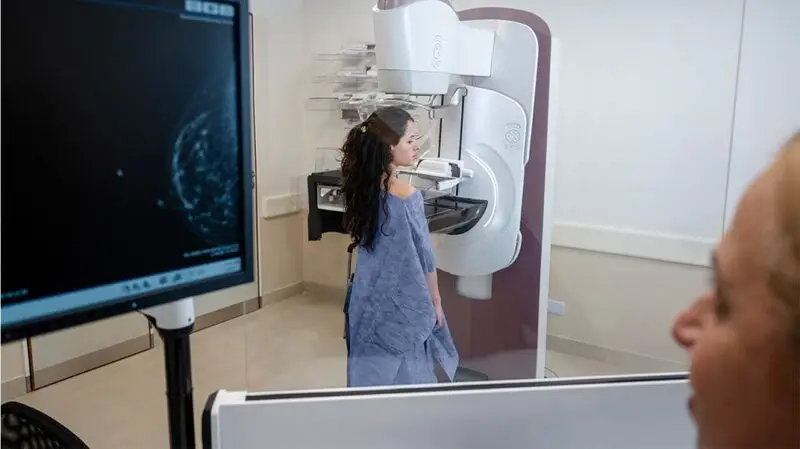
- Artificial intelligence (AI)-supported mammography may help enable earlier detection of clinically relevant and aggressive breast cancers.
- Evidence from a large-scale trial suggests that using AI-supported mammography led to a 12% reduction in interval breast cancers, with 27% fewer aggressive cancers, compared with standard screening.
- AI-supported screening also increased the sensitivity while maintaining the same specificity, which resulted in a higher cancer detection rate without increasing false-positive findings.
- The findings also indicate that the AI-support can help reduce radiologist workload at scale.
Breast cancer screening, primarily through mammograms, is crucial for detecting breast cancer early, often before symptoms appear. Finding cancer early can dramatically
Guidelines for breast cancer screening vary depending on an individual’s risk, but recommendations
This describes a breast cancer that is diagnosed between mammogram screenings. Interval cancers occur in about 10 to 20 out of every 10,000 women who have mammograms every 2 years and make up around 20 to 30% of all breast cancers diagnosed in these women.
Interval breast cancers are generally larger, faster-growing, spread more quickly, and have a worse outlook than those found on screening mammograms.
A recent study published in
Speaking to Medical News Today, study lead Kristina Lång, MD, PhD, associate professor in Diagnostic Radiology at Lund University and consultant in breast imaging at Unilabs Mammography unit in Malmö, had the following to say:
“The MASAI trial demonstrates that AI-supported mammography screening increases cancer detection by 29% without increasing false positives, reduces interval cancers by 12%, and lowers radiologists’ reading workload by 44%.”
— Kristina Lång, MD, PhD
“Importantly, AI enabled earlier detection of clinically relevant invasive and aggressive cancers while they were still relatively small and was associated with fewer interval cancers of these subtypes, suggesting potential improvements in outcomes for women participating in screening,” she added.
The research comes from the Mammography Screening with Artificial Intelligence (MASAI) trial, which is assessing whether AI can improve the efficacy of mammography screening. In particular, this study examines whether AI can reduce interval cancer rates while also easing radiologists’ workload.
The MASAI trial is a large-scale randomized study that included more than 105,000 women. It evaluated the use of Transpara Detection, an AI tool developed by ScreenPoint Medical, during population-based breast cancer screening in Sweden.
Participants were randomly assigned either to standard double reading by radiologists or to an AI-supported screening pathway, in which AI assisted in prioritizing mammograms for review.
Overall, there were 12% fewer interval cancers with AI-supported screening compared to standard screening. Additionally, interval cancers after AI-supported screening also had a more favourable profile. There were 16% fewer invasive cancers, 19% fewer large cancers, and 27% fewer aggressive subtypes.
Study author Jessie Gommers, PhD, Division of Diagnostic Radiology at Lund University and Department of Medical Imaging, Radboud University Medical Centre, Netherlands, also spoke to MNT.
“Interval cancers are often associated with poorer outcomes. The lower number of interval cancers in the AI-supported group, along with their less aggressive characteristics, suggests a meaningful clinical benefit for patients,” she said.
“The increased overall cancer detection with AI means more cancers are identified during screening, which may allow for earlier treatment, less invasive procedures, and improved outcomes. Ongoing analyses of cancers detected at subsequent screening rounds will provide further insight into the long-term impact of AI-supported screening.”
— Jessie Gommers, PhD
The study also found that AI support increased screening sensitivity without compromising specificity.
Sensitivity, which describes the ability to correctly identify cancers, was 6.7 percentage points higher in the AI group compared with standard screening (80.5% vs. 73.8%), while specificity, indicating the ability to correctly identify those without cancer, remained the same at 98.5%.
Importantly, the reduction in interval cancers did not come at the cost of more
The consistent improvement in sensitivity was observed across age groups and breast density subgroups, suggesting broad applicability across screening populations.
Earlier MASAI findings, published in
The AI tool functions as ‘a second pair of eyes’, which can help radiologists to prioritize high risk cases and focus attention where it is most needed. The system is designed for both 2D and 3D mammography and has been evaluated in many peer-reviewed publications.
According to ScreenPoint Medical, the technology has demonstrated consistent performance across varying breast densities, ethnic backgrounds, and levels of radiologist experience.
Commenting on the potential impact on real-world screening programs, Gommers said:
“These results show that AI may help radiologists in detecting more clinically relevant breast cancers while substantially reducing workload. This has the potential to both improve patient outcomes and alleviate workload, which is particularly important given the ongoing shortage of radiologists.”
The results of the MASAI trial could represent a significant step forward in understanding how AI can be safely and effectively integrated into population-based breast cancer screening.
AI-supported mammography screening could help to identify dangerous cancers earlier, reduce the burden of interval cancers, and support overstretched screening programs. Integrating these tools may improve the effectiveness and sustainability of breast cancer screening. However, while the results are promising, longer follow-up trials are still necessary.
When asked about the potential role of AI in screening, Lång noted:
“I think AI will be implemented in screening in the future. Several ongoing studies are currently evaluating similar AI-based strategies, and their results will be important to determine whether the findings from the MASAI trial can be replicated and further strengthen the evidence base.”
“Cost-effectiveness also needs to be determined to assess whether the additional costs of AI are offset by reduced radiologist workload and fewer invasive procedures due to earlier cancer detection. A cost-effectiveness analysis on the MASAI trial is underway,” she continued.
Will AI help reduce costs?“A recent modelling study from Norway has suggested that AI-supported mammography screening may be cost-effective if it leads to a reduction in interval cancers of around 5%. In our study, we observed 12% fewer interval cancers following AI-supported screening. While cost-effectiveness has not yet been evaluated, this reduction suggests that the approach has the potential to be cost-effective.”
— Kristina Lång, MD, PhD
“If AI-supported screening is decided to be implemented more widely, it will be important to monitor AI performance, to train radiologists to work effectively with AI, and to ensure that women understand that the AI used in the MASAI trial supports but does not replace radiologists, who continue to make all final recall decisions,” Lång added.